The headline numbers are extraordinary. But what economic value will the Maldives actually retain?
Foreign investment can accelerate development in a small economy such as the Maldives. It can bring capital, expertise and opportunities that domestic resources alone may take much longer to create.
The question, therefore, is not whether foreign investment is good or bad. It is whether the terms on which investment takes place create sufficient and lasting value for the Maldives.
And where scarce national assets and long-term rights are involved, other critical considerations remain: What does the Maldives receive, what do we give in return, and what remains for our future generations?
What has been agreed on exactly?
Before considering the US$20 billion headline, the more fundamental question is what exactly has been agreed to on behalf of current and future generations of Maldivians?
Gross Foreign Direct Investment (FDI) is not the same as net foreign exchange retained.
Eagle Hills describes the document signed with the Government as a “commercial terms agreement” setting out the shared vision and principal commercial terms of the project, with detailed terms to be developed as the project progresses.
That distinction matters for a project of this scale and duration.
Which terms are already binding? Which remain to be negotiated? And what conditions must be satisfied before development rights are exercised and construction proceeds?
These questions do not suggest that development will proceed without the necessary agreements. The publicly available information does not establish that.
What it does mean however, is that the commercial terms announced so far should be distinguished from the detailed contractual framework still to follow.
What exactly is the $20 billion?
Eagle Hills has described approximately USD20 billion of investment across several phases. Broader projections have included more than USD30 billion in gross foreign investment over the project’s lifetime and approximately USD18 billion in net foreign investment.
These numbers may barely be reconcilable. But they are not interchangeable.
A development value is not necessarily capital committed. Gross Foreign Direct Investment (FDI) is not net foreign exchange retained. And lifetime investment is not money arriving in the Maldives today. Nor does it necessarily mean reserves retained and built up over time.
Time matters too. USD20 billion deployed over five years would be a very different economic event from the same amount deployed over fifteen or twenty years. Therein lies another important two-parter: How much capital will actually enter the Maldives, and when?
The $2 billion tourism question
At maturity, which the Minister of Infrastructure has indicated would be in roughly ten years, RasMalé is expected to generate more than USD2 billion in annual tourism revenue.
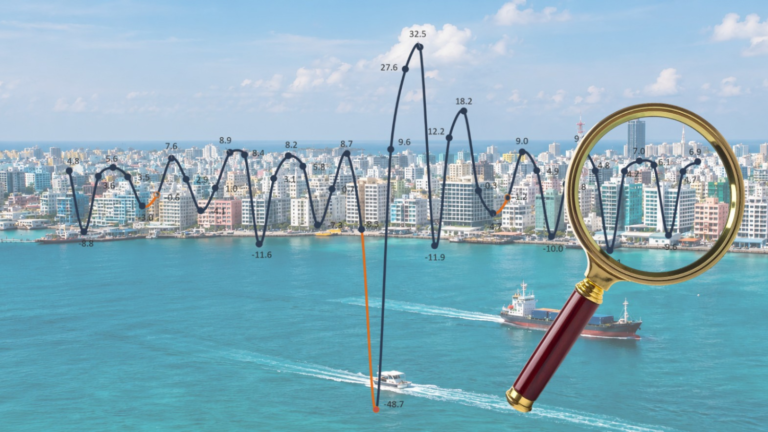
That is indeed substantial. But the Maldives already recorded approximately USD5.57 billion in travel receipts in 2025 while continuing to face foreign-exchange pressures. This does not diminish the potential value of another USD2 billion. It illustrates why gross tourism revenue alone cannot tell us the economic impact.
Some tourism expenditure ultimately leaves the economy through imports and other external payments.
Gross revenue is not the same as economic value retained. The more deafening questions now therefore are: What is the projected revenue path over those ten years? And how much of the USD2 billion at maturity is expected to remain within the Maldivian economy and contribute to net foreign-exchange availability?
Where does the investment actually remain?
The same issue arises with the projected USD30 billion in gross foreign investment and approximately USD18 billion described as net foreign investment.
Net of what? Does the calculation account for foreign procurement, external services, financing costs and other outward flows?
The important measure is therefore not simply how much investment enters, but how much value remains.
Foreign capital can enter the Maldives and subsequently leave to pay overseas suppliers, contractors, lenders and service providers.
The important measure is therefore not simply how much investment enters, but how much value remains through Maldivian businesses, employment, services, taxation and net Foreign Exchange (FX).
Who supplies the project? Who provides its services? Where are the workers employed? Where do the profits accrue?
The answers matter far more than the nationality of the investor.
Jobs and State revenue
The project is expected to generate more than 54,000 direct and indirect jobs over its lifetime.
That could be significant. But a lifetime employment estimate is not the same as 54,000 permanent jobs.
How many are construction jobs? How many are permanent? Direct or indirect? Maldivian? And over what period?
A continuing revenue stream could ultimately be worth substantially more than a one-off payment.
The Minister has also provided more detail on State revenue. He says the Government will receive normal Tourism Goods and Services Tax (TGST) without concessions, a 10 percent share of master-developer revenue and four percent on property transactions. The State expects more than USD11 billion in revenue over the development period.
The consideration is therefore no longer what simply constitutes that USD11 billion. It is:
How is the USD11 billion projection derived, over what period, and what assumptions about property sales, tourism activity and project development justify it?
Does the Maldives give up anything in return?
The Government’s stated approach is to participate in the continuing economic activity generated by RasMalé rather than rely principally on an upfront payment.
There is economic logic to that proposition. A continuing revenue stream could ultimately be worth substantially more than a one-off payment.
But the comparison requires both sides of the transaction.
What is the economic value of the development rights granted by the Maldives, compared with the risk-adjusted present value of the revenues and other benefits expected in return?
The proposed 5,000 homes in Hulhumalé illustrate the same principle.
The Minister says Eagle Hills will finance the homes upfront, at an estimated cost of USD400–500 million, with the cost subsequently deducted from the Government’s 10 percent share of project revenue.
This avoids an immediate call on government borrowing.
But in economic terms, part of the Government’s future share of project revenue would be exchanged for housing delivered upfront.
That may be worthwhile. But it should form part of the overall assessment of what the Maldives receives and gives in return.
The 99-year question
Eagle Hills states that properties will be offered under leasehold arrangements of up to 99 years and that:
“Upon each transfer, whether through sale or inheritance, a new leasehold term of up to 99 years will commence.”
The Government has made clear that this is not freehold, that Maldivian law continues to apply, and that property ownership does not confer permanent residency or citizenship.
Those are important safeguards. But a separate economic question remains. If a transfer can begin a new leasehold term of up to 99 years, can that process repeat indefinitely?
A bigger development does not automatically produce a proportionately greater national economic benefit.
Is the new term automatic? Does it require State approval or additional consideration? What happens on successive transfers?
And what rights does the State retain over these properties fifty, one hundred or two hundred years from now?
That is not merely a property question. It is an intergenerational one.
The Crossroads question
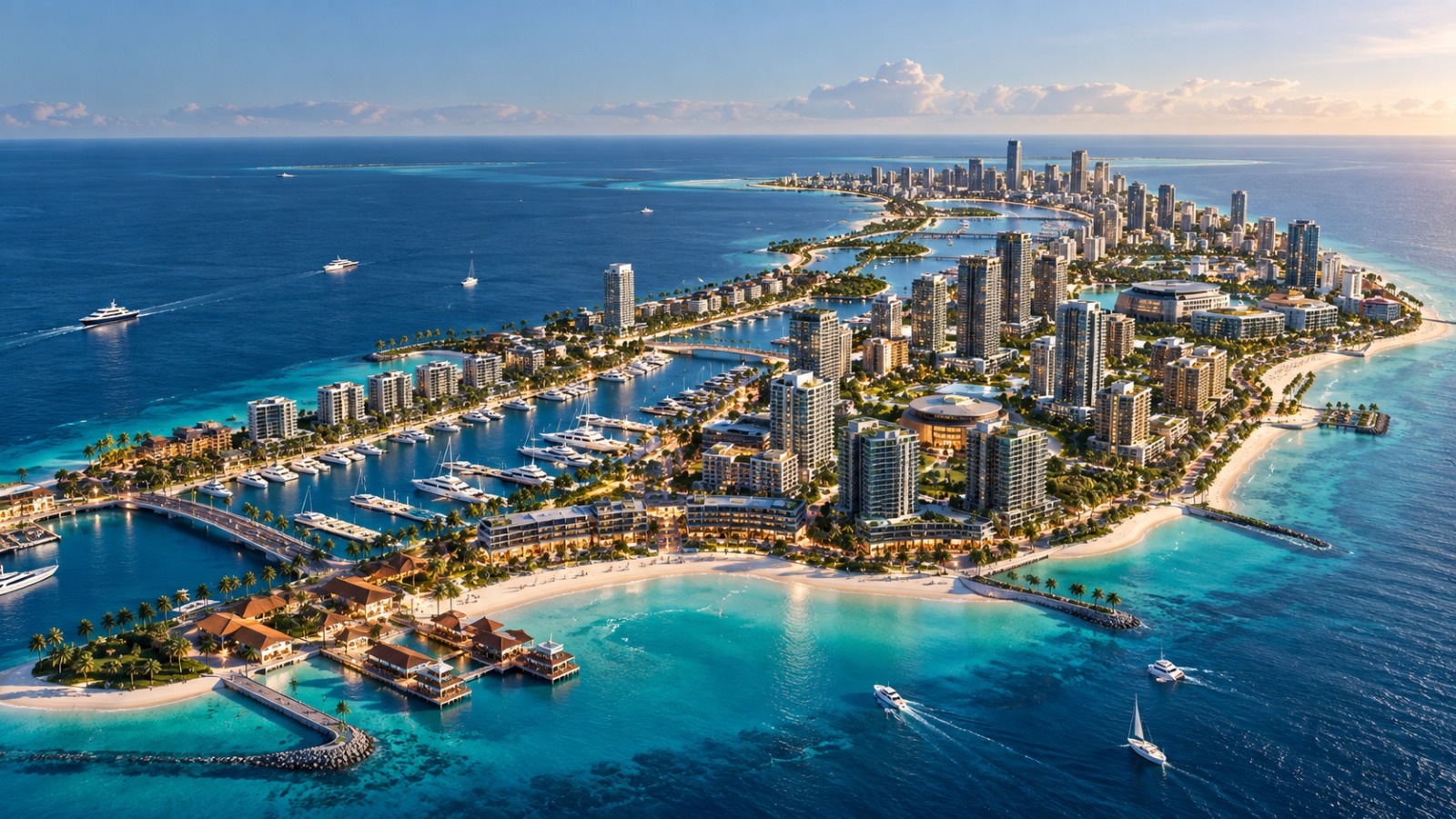
RasMalé is broader and substantially larger than previous integrated developments in the Maldives. It combines hospitality, residences, retail, leisure, wellness, a marina and other urban functions.
But the Maldives already has experience with large integrated hospitality and real-estate developments.
So the relevant question is not whether RasMalé and previous developments are equivalent. It should be: What features of the RasMalé model will allow it to retain substantially more economic value within the Maldives than previous integrated developments?
A bigger development does not automatically produce a proportionately greater national economic benefit.
The questions behind the headlines
The scale of RasMalé naturally attracts attention. But the larger the numbers, the more important it becomes to understand what lies behind them.
| The headliner | What remains unclear |
|---|---|
| Commercial terms agreement | What has been settled and what remains to be negotiated? |
| USD20 billion | How much capital will actually be deployed, and when? |
| USD30 billion gross FDI | Calculated how? |
| USD18 billion net FDI | Net of what? |
| USD2 billion annual tourism revenue | How much will remain as domestic value and net FX? |
| 54,000 jobs | What kind, and over what period? |
| USD11 billion State revenue | Based on what assumptions and over what period? |
| Development rights | What is their economic value relative to what the State receives? |
| 99-year leases | What happens over successive transfers? |
And ultimately: How much economic value remains in the Maldives, and what rights and opportunities remain for future generations?
These are not arguments against RasMalé or foreign investment.
They are the questions required to distinguish between a large development proposition and a large economic proposition.
The real RasMalé question
RasMalé may ultimately become one of the largest developments in the history of the Maldives. It may generate substantial investment, employment, tourism and State revenue.
Where rights over scarce national assets extend across generations, the assessment cannot end with today’s economic flows.
But those outcomes need to be understood through the numbers behind the headlines. Why? Because:
- Investment is not the same as retained wealth
- Gross revenue is not the same as net FX
- Tourist arrivals are not the same as economic value
- Jobs are not the same as household wealth
- And a USD20 billion development is not automatically a USD20 billion injection in to the Maldivian economy
Where rights over scarce national assets extend across generations, it is always pertinent to consider that there is also a question beyond today’s economic flows.
The real measure of RasMalé will not be how much money passes through it, but how much economic and national value the Maldives, and Maldivians, retains from it, today and for generations to come.