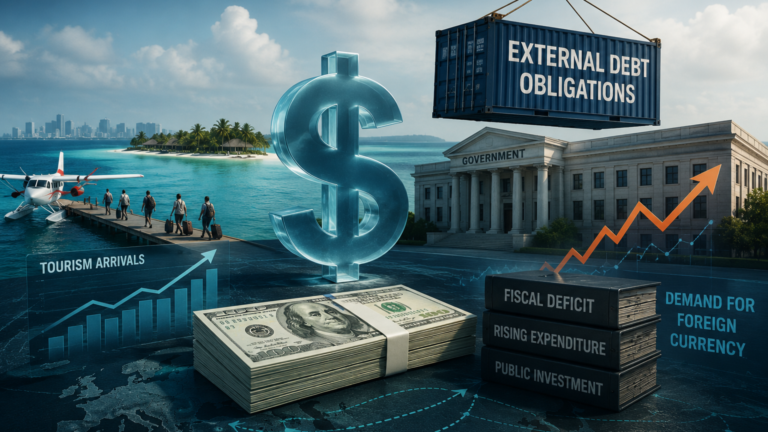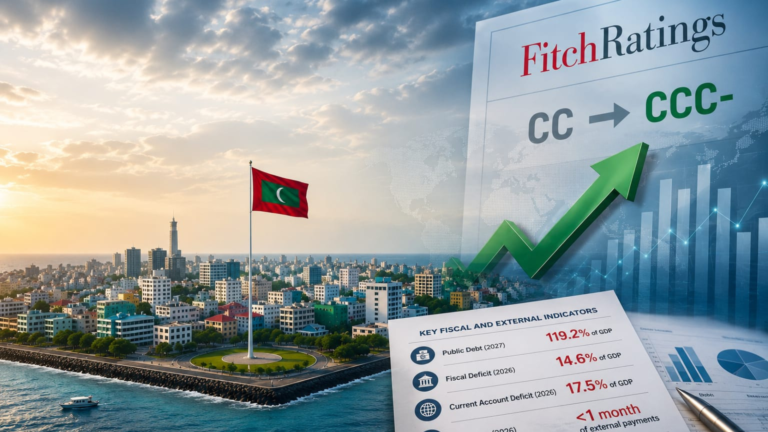

The Maldives has successfully met some of its biggest external debt obligations of 2026. But that achievement hides what might be a harrowing predicament.
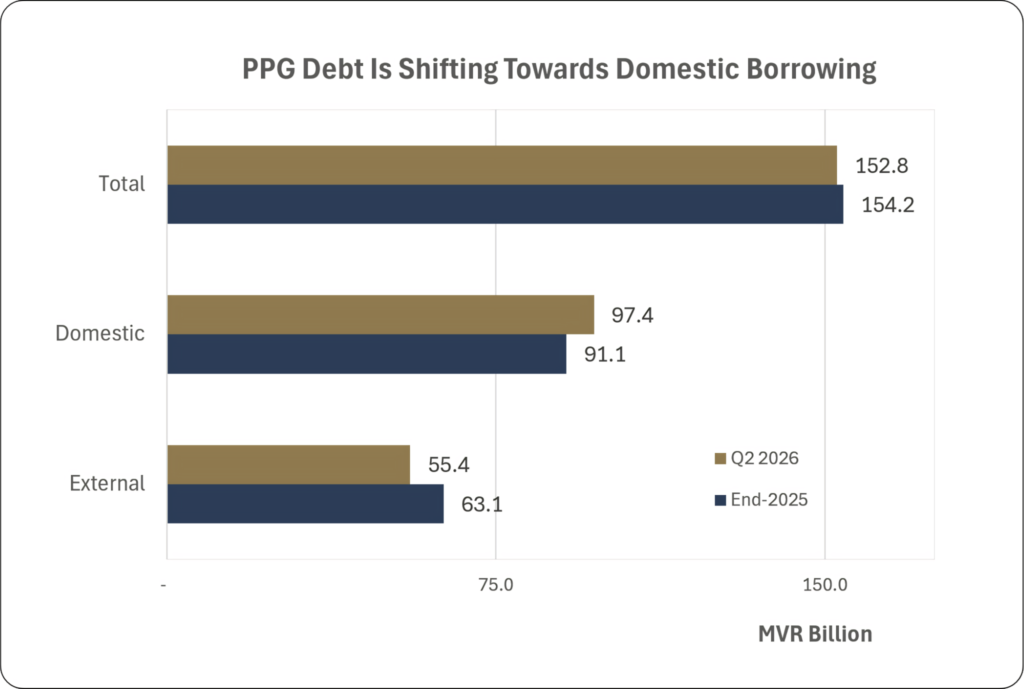
Public and publicly guaranteed (PPG) debt still stands at a concerning 122.7 percent of GDP. Domestic PPG debt has risen to MVR 97.4 billion. The overall fiscal balance remains in deficit. And while gross official reserves stood at USD638 million at end-July, the usable-reserve proxy was only about USD222 million.
Source: Ministry of Finance and Public Enterprises, Quarterly Debt Bulletin, Q2 2026.
These numbers point to an important distinction. The Maldives has demonstrated its ability to pay major obligations as they fall due. It has not yet demonstrated that the underlying debt problem has been resolved.
The headline debt ratio has improved. PPG debt fell from 129.3 percent of GDP at end-2025 to 122.7 percent by June 2026. External debt also declined substantially. These are significant developments.
But look beneath them and the nature of the problem begins to reveal itself.
Where has the debt gone?
External PPG debt fell from MVR 63.1 billion at end-2025 to MVR 55.4 billion by June 2026. Over the same six months, domestic PPG debt moved in the opposite direction, rising from MVR 91.1 billion to MVR 97.4 billion. By June, domestic PPG debt alone was equivalent to 78.2 percent of GDP.
The debt burden is not simply falling. It is shifting. Part of it is shifting inward.
As the State becomes increasingly dependent on domestic finance, banks and other financial institutions have to absorb more government debt.
That changes the nature of the risk. External debt exposes the country directly to foreign-exchange and external refinancing pressures. Greater reliance on domestic borrowing reduces some of that immediate external exposure, but places more of the financing burden on the domestic financial system.
The IMF has also identified the elevated sovereign-bank nexus as a macro-financial risk.
And this matters beyond the government’s own balance sheet. When the State becomes increasingly dependent on domestic finance, banks and other financial institutions have to absorb more government debt. Over time, this can compete with financing that might otherwise support businesses, investment and economic activity.
What did it cost to get through 2026?
The size of the repayments already made also provides another perspective on the debt problem.
During the second quarter alone, PPG debt service amounted to MVR 16.95 billion, of which MVR 14.90 billion was principal repayment.
MVR 16.95 billion: PPG debt service in Q2 2026, of which MVR 14.90 billion was principal repayment.
Meeting those obligations removed an immediate risk. But it did not remove the debt that remains, nor the need to finance future repayments.
There is an encouraging signal in the fiscal accounts. By 3 September 2026, the government recorded a primary surplus of MVR 1.27 billion. But after financing and interest costs, the overall fiscal balance remained in deficit by MVR 2.13 billion.
That difference goes to the heart of debt sustainability.
If servicing yesterday’s borrowing continues to leave the government with a financing gap today, new financing remains necessary. And if that financing adds to tomorrow’s obligations, the debt cycle remains unbroken.
A primary surplus is therefore important. But what ultimately matters is whether sufficiently strong fiscal balances can be sustained long enough to reduce borrowing requirements and place debt on a persisting downward trajectory.
How much external buffer remains?
The external side of the balance sheet presents a different vulnerability.
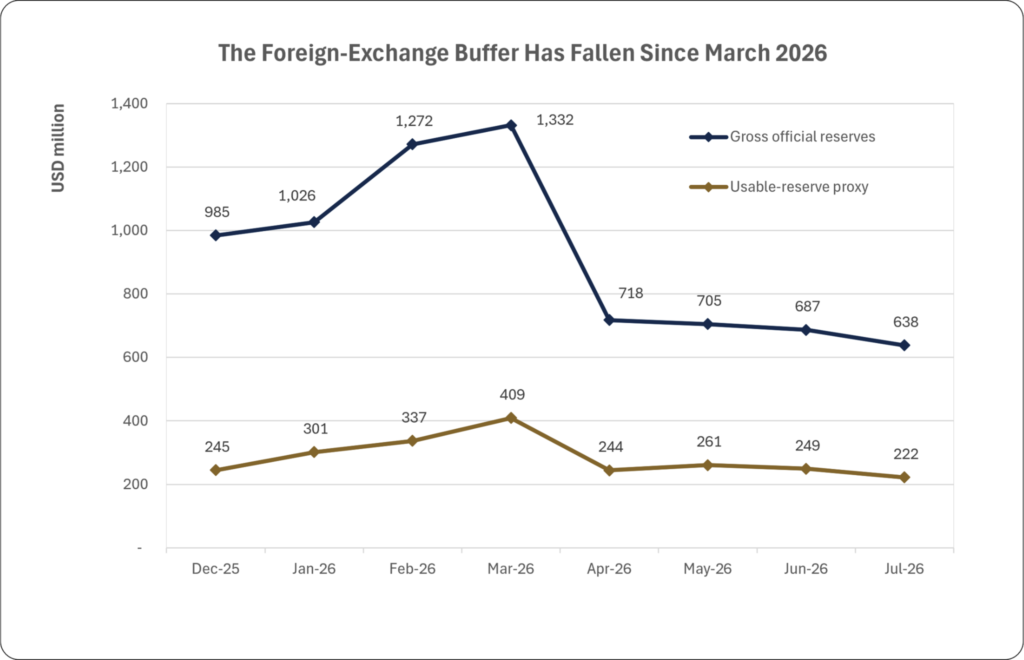
At end-July, gross official reserves stood at USD638 million. But gross reserves alone do not show the full extent of the foreign-exchange buffer.
Source: Maldives Monetary Authority. Usable-reserve proxy calculated using MMA’s stated methodology.
The MMA’s reserve table states that official reserve assets, other foreign-currency assets and predetermined short-term net drains can be used as a proxy for its previously published usable reserves. Applying that methodology gives a July usable-reserve proxy of approximately USD222 million.
The difference is substantial;
- Gross official reserves: USD638 million
- Usable-reserve proxy: approximately USD222 million
Against merchandise imports of around USD3.62 billion in 2025, the usable-reserve proxy represents approximately 0.7 months, or a mere three weeks, of imports.
Import cover should not be interpreted as a countdown to the country running out of foreign currency. But less than one month of import cover provides a thin cushion for a highly import-dependent economy that must simultaneously meet external debt obligations.
The direction of movement also deserves attention. The usable-reserve proxy had reached approximately USD409 million in March 2026. By July, it had fallen to about USD222 million. Gross official reserves fell over the same period from approximately USD1.33 billion to USD638 million.
If new financing adds to tomorrow’s obligations, the debt cycle has not yet been broken.
The IMF’s June assessment recognised that recent repayments had alleviated immediate solvency concerns, while continuing to assess the risks of overall and external debt distress as high.
The real test comes next
The Maldives has crossed an important repayment hurdle. The debt-to-GDP ratio has declined. External debt has fallen. And the fiscal accounts show a primary surplus.
Those developments deserve recognition.
However, now is not the time to rest on our laurels. Alongside are another set of critical facts;
- PPG debt remains above 120 percent of GDP
- Domestic debt is rising
- Overall fiscal balance remains in deficit
- Debt servicing is absorbing substantial resources and
- Usable foreign-exchange buffer remains thin
That is why paying debt should not be confused with solving the debt problem.
Debt becomes sustainable when each repayment leaves the country better placed to meet the next one, without repeatedly increasing domestic borrowing, widening fiscal financing needs or drawing down on an already thin foreign-exchange buffer.
The Maldives has shown that it can meet a major repayment. The more important test now is whether today’s policies are making the next major repayment easier to meet.