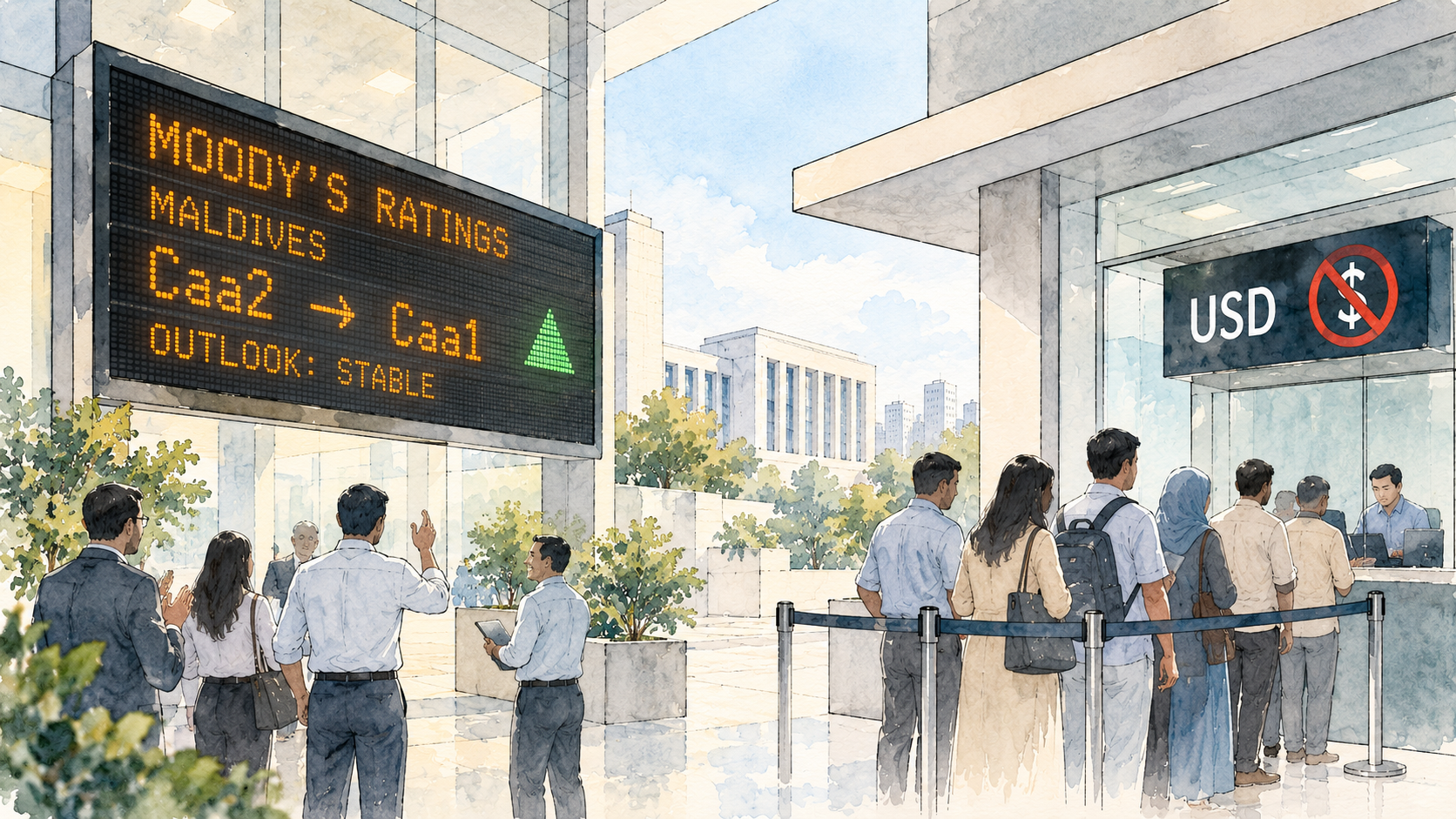
Moody’s decision to upgrade the Maldives’ sovereign credit rating from Caa2 to Caa1, while maintaining a stable outlook, is a welcome development. It recognises a significant reduction in the Maldives’ immediate risk of default following the repayment and refinancing of major external obligations.
However, an improvement in the Government’s ability to meet its external commitments does not necessarily mean that foreign currency has become more accessible to businesses and households.
This distinction is important when decoding both the significance and the limitations of the upgrade.
What has improved?
Moody’s identifies the repayment of the USD500 million sukuk in April 2026, settlement of obligations to the Reserve Bank of India (RBI) and State Bank of India (SBI), and the extension of a USD100 million external obligation to 2031 as important developments.
These actions have eased immediate repayment pressures. Of the nearly USD1.9 billion in public and publicly guaranteed external debt service due in 2026, Moody’s estimates that USD411 million remains payable in the final quarter. The amount due in 2027 is considerably lower, at USD428 million.
The rating agency also acknowledges that foreign exchange (FX) regulations, increased collection of tourism-related revenues in dollars and continued access to external financing have strengthened the Government’s ability to meet its obligations.
These are meaningful improvements. The Government is now in a better position to manage the nation’s near-term external payments.
Dollar shortages in the wider economy
For businesses and households however, access to US dollars remains a significant concern. Restrictions on dollar withdrawals, limits on international card transactions and delays in overseas bank transfers continue to cause difficulties. These are familiar frustrations for many Maldivians, reflected in the complaints regularly shared on social media.
For businesses dependent on imports and overseas suppliers, these difficulties can disrupt operations and create uncertainty. For households, they complicate payments for education, medical treatment, travel and other overseas commitments.
The Government has reason to celebrate Moody’s upgrade. But for businesses and households struggling to access dollars, there is little reason for celebration.
Moody’s assessment focuses on sovereign creditworthiness and not how easily businesses and individuals can obtain dollars through the banking system.
This raises a broader question about foreign exchange policy. Measures that strengthen the Government’s capacity to meet external obligations are important, but their effectiveness must also be assessed against the availability of foreign currency for legitimate private transactions.
Moody’s itself cautions that usable reserve coverage remains weak compared with similarly rated countries. This is particularly relevant to an import-dependent economy operating under a fixed exchange rate.
The fiscal challenges remain
The upgrade does not mean the Maldives has overcome its underlying fiscal difficulties.
Moody’s expects the Maldives’ debt to remain above 100 percent of GDP over the next few years and projects a fiscal deficit of 8.0 to 8.5 percent of GDP in 2026, exceeding the Government’s original budget target of 7.1 percent.
The agency also highlights large domestic refinancing requirements, recognising that continued reliance on domestic borrowing can place pressure on financial institutions and constrain the availability of financing for private investment.
In welcoming the upgrade, the Ministry of Finance points to the reduction in public and publicly guaranteed debt from 129.2 percent of GDP at the end of 2025, to 122.6 percent by July 2026.
While encouraging, this reduction does not by itself establish a sustainable downward debt trajectory. That would require continued fiscal consolidation, manageable borrowing requirements and the ability to meet future obligations without recurring financial stress.
Significantly, Moody’s rating committee concluded that the country’s underlying economic fundamentals, institutional strength and fiscal or financial strength had not materially changed.
The upgrade reflects a reduction in immediate default risk, rather than a fundamental improvement in the country’s fiscal position.
Beyond the rating upgrade
The improvement in the sovereign rating provides the Government with an opportunity to address the vulnerabilities that remain.
The priority must be to reduce fiscal deficits, contain new borrowing, strengthen usable foreign exchange reserves and gradually reduce dependence on refinancing existing debt.
At the same time, the continuing difficulties businesses and households face in accessing dollars also deserve considerable attention. A stronger sovereign payment position is important, but is only one part of a functioning foreign exchange market.
The real test is not simply whether the Government can meet the nation’s external obligations, but whether the Maldives can build a more sustainable fiscal position while ensuring that businesses and households can meet theirs.